
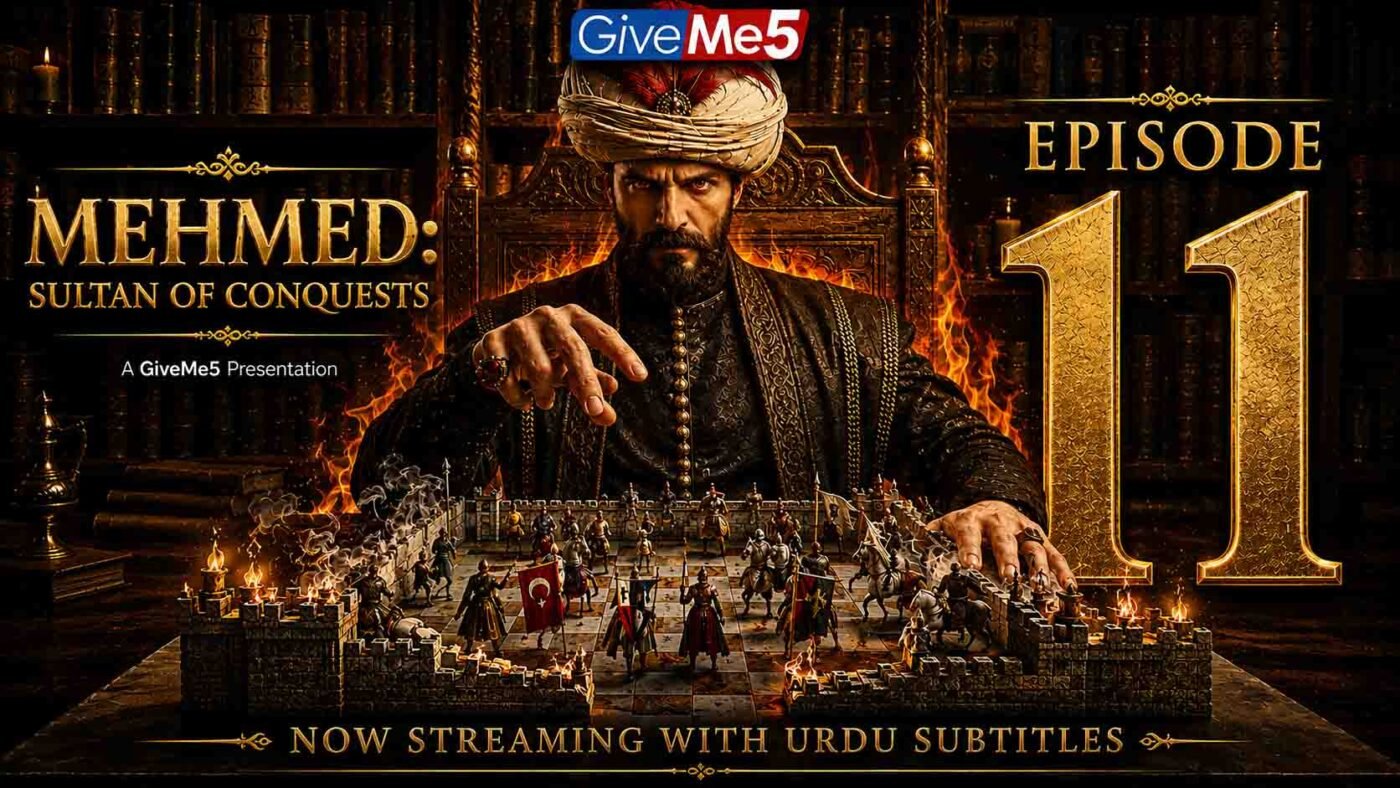
Sultan Mehmed Fateh Episode 11 with Urdu Subtitles by GiveMe5 takes the story into a tense new phase as Sultan Mehmed moves closer to his dream of conquering Constantinople. While enormous cannons are being prepared and a new citadel rises across from the Byzantine capital, enemies begin forming plans to stop the Ottoman advance. At the same time, conflicts within the palace, questions surrounding Mihriban, the ambitions of Orhan, and the arrival of Hizir Celebi create another layer of danger for the young Sultan.
The episode begins with Sultan Mehmed making his intentions unmistakably clear. The enormous cannons being cast for the coming campaign are already causing concern among his enemies. Mehmed confidently declares that when these weapons reach the battlefield, the balance of power will change. His words reveal how firmly Constantinople has become the center of his ambitions. He does not see the city merely as another military objective; he believes its conquest is a destiny that must eventually be fulfilled.
Mehmed’s determination is immediately contrasted with the doubts of those around him. Ishak Pasha discusses the previous Ottoman attempts against Constantinople and remembers how earlier armies had failed to overcome its formidable walls. The failures of Bayezid, Musa Celebi, and Sultan Murad remain fresh in the minds of experienced statesmen. For them, the dream of Constantinople is filled with memories of armies returning home defeated. Mehmed, however, refuses to allow the failures of previous generations to determine his own future.
One of the most important developments is Mehmed’s decision to strengthen the Ottoman justice system. Complaints from ordinary people continue to reach the Sultan, and he wants a capable scholar who can examine these problems fairly. This leads him toward Hizir Celebi, a respected scholar who has withdrawn from political life and spends his days caring for orphans. Hizir initially refuses to return to the capital because of his opposition to Candarli Pasha, but Mehmed eventually visits him personally.
Their meeting becomes one of the most meaningful moments of the episode. Rather than simply ordering Hizir to return, Mehmed understands his concern for the children. He proposes building an orphanage in the capital so that the children can remain under the protection of the state. This decision demonstrates that Mehmed’s vision of a powerful empire is not limited to armies and conquest. He also wants a state capable of protecting its weakest people.
Hizir Celebi eventually begins serving as the new Head Qadi, and his approach to justice quickly becomes visible. In one memorable case, he investigates a dispute involving a horse whose owner claims that a badly made horseshoe caused the animal to suffer. Hizir listens to both sides, identifies who is responsible, and orders appropriate punishment while also ensuring that the injured horse receives care. The scene establishes Hizir as a strict but thoughtful judge who believes justice must protect both rights and responsibility.
Meanwhile, Sultan Mehmed continues building his intellectual vision for the Ottoman state. His conversations about books, knowledge, and civilization show that he does not believe military power alone can create a great empire. He studies works from both Eastern and European scholars and insists that progress requires freedom of thought and learning. He explains that a strong state needs books as much as swords. His ambition is to create a fair, powerful state that can stand alongside the greatest civilizations of history.
This interest in knowledge also leads Mehmed toward Cavit Effendi and his extensive collection of books. The Sultan is impressed by works gathered from Rome, Egypt, Iran, and Samarkand and decides that the collection should become part of the palace library. He ultimately considers giving Cavit a position in the library so that his knowledge and ability to understand different languages can benefit the state.
At the same time, the military preparations continue at an extraordinary pace. Master Urban works on increasingly powerful artillery, while Mumin Ali develops heavy cannonballs using a mixture of stone, marble, iron, copper, and bronze. The goal is to create ammunition powerful enough to withstand the tremendous force of the new cannons. Mehmed orders the work to be accelerated because the future campaign against Constantinople will depend heavily on these weapons.
The Sultan then announces that the newly constructed cannon will be fired for the first time. He deliberately invites the viziers, including Candarli Halil Pasha, to witness the demonstration. Mehmed knows that some of his most powerful advisers doubt whether Constantinople can actually be conquered. Instead of arguing with them, he wants the cannon itself to provide the answer. The first firing is therefore not simply a technological demonstration—it becomes a test of faith in Mehmed’s vision.
But while the Ottoman military prepares for the future, the Byzantine side is preparing its own response. The new Ottoman citadel is being constructed directly across from the existing fortress, increasing Byzantine fears. Plans are made to divide the Ottoman Akıncı forces and launch an attack near the fortress. Orhan Bey is also brought into the plan because of his desire for revenge against Bali Bey. The Byzantine side hopes that destroying Ottoman raiders will send a powerful message to Mehmed after the Byzantine messenger was killed.
The danger becomes even greater when Mara Hatun becomes part of the political struggle. Orhan wants Mara, and those working against Mehmed see her departure from the Ottoman capital as a way to prevent the Sultan from attacking Constantinople while she remains connected to the Byzantine side. A plan is therefore developed to manipulate circumstances so that Mara herself will want to leave the palace.
Inside the palace, the tension surrounding Mihriban also grows. A letter reveals that she has been sending money and messages connected to her family. Gulsah discovers the correspondence, while Mara becomes suspicious of Mihriban’s actions. Mehmed learns about the letter but chooses mercy because of their shared past. Later, Mihriban admits to Mustafa that she acted out of desperation and even reveals how deeply her guilt has affected her. Mustafa decides that their relationship must end and promises to keep what happened secret to protect her.
The conflict surrounding Hala Sultan becomes even more complicated. Mara investigates a private letter and discovers that it is connected to an orphanage being established in Bursa. What initially appears suspicious turns out to have a very different explanation. Hala Sultan had been secretly sending gold to support the project. Her actions reveal that the palace intrigues cannot always be understood simply through suspicion, and even those who appear politically dangerous may have personal reasons for their decisions.
The episode also gives attention to the growing tension within the Janissary organization. Kara Mustafa Agha works to establish discipline among the recruits, emphasizing brotherhood, tradition, faith, and obedience. At the same time, Halil Pasha remains concerned about how the Janissaries are being used for the Sultan’s preparations. The political struggle between those who support Mehmed’s vision and those who fear its consequences continues to intensify.
As the episode approaches its climax, the long-awaited cannon demonstration finally takes place. Candarli Halil Pasha is expected to witness the first firing, but his illness prevents him from arriving. Mehmed learns that his Grand Vizier is absent and questions why he was not informed. Instead of allowing the moment to pass, Mehmed chooses Mumin Ali to fire the cannon for the first time. The enormous weapon is finally prepared, symbolizing the transformation of Mehmed’s dream from an idea into a practical military campaign.
However, the episode ends on a far more tragic note. Outside the main preparations, the Ottoman raiders are attacked. Bali Bey and his men face a dangerous enemy ambush, and the fighting results in devastating losses. Hasan is found badly wounded, while Saltuk also falls in the struggle. The emotional impact of these scenes reminds viewers that Mehmed’s great ambitions will demand enormous sacrifices from those fighting to make them possible.
Sultan Mehmed Fateh Episode 11 therefore brings together ambition, justice, knowledge, political intrigue, military innovation, and sacrifice. Mehmed is no longer merely dreaming about Constantinople. The cannons are being built, the citadel is rising, the army is preparing, and the political consequences of his decisions are spreading across the region. Yet with every step toward the conquest, the opposition becomes stronger and the personal cost becomes greater.
As Sultan Mehmed moves closer to the walls of Constantinople, his greatest challenge may not simply be breaking the city’s defenses. He must also keep his state united, manage those who doubt him, protect the people who depend on him, and survive the conspiracies developing around him. Watch Sultan Mehmed Fateh Episode 11 with Urdu Subtitles by GiveMe5 to follow this crucial stage in Mehmed’s journey toward the destiny that will eventually make him known as Fatih, the Conqueror.
